

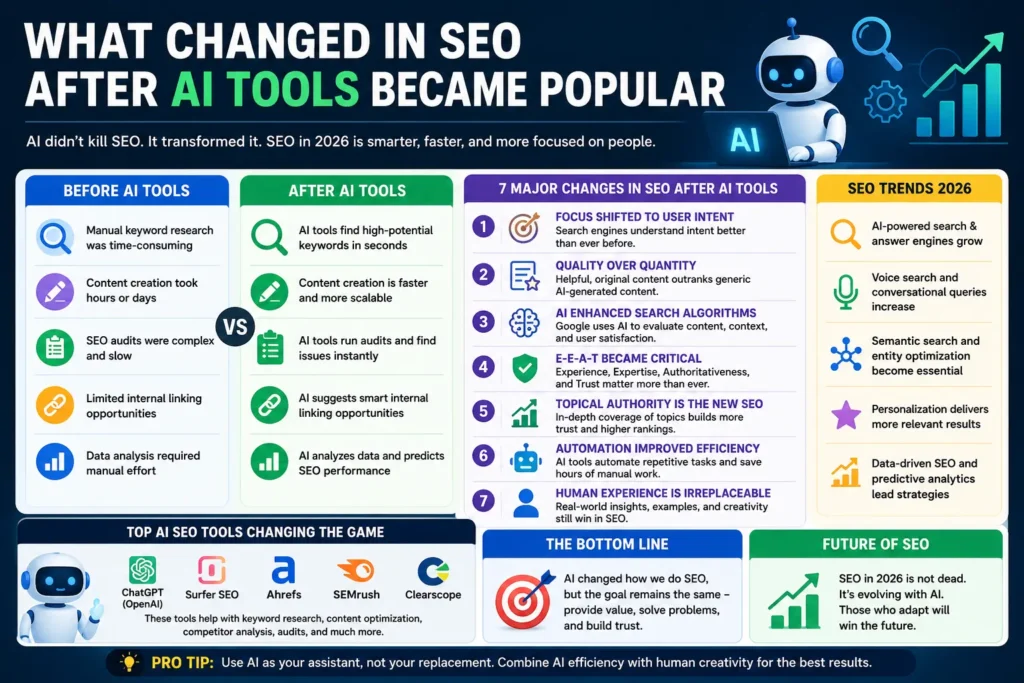
What Changed in SEO After AI Tools Became Popular
Artificial Intelligence changed digital marketing faster than most experts expected.
A few years ago, SEO professionals manually handled keyword research, content writing, optimization, and data analysis. Today, AI tools complete many of those tasks within minutes.
This shift created one big question:
Has AI completely changed SEO?
The answer is yes. But not in the way many people think.
SEO is not dead. Instead, AI transformed how websites compete in search results. Search engines now prioritize content quality, user experience, expertise, and topical authority more than ever.
In this guide, I will explain the biggest SEO changes after AI tools became popular and what businesses must do to stay competitive in 2026.
How AI and SEO Became Closely Connected
AI now plays a major role in modern SEO strategies.
Search engines like Google already use artificial intelligence in their ranking systems. Algorithms like RankBrain and helpful content systems rely heavily on machine learning.
At the same time, marketers started using AI SEO tools for:
- Content generation
- Keyword clustering
- SEO audits
- Competitor analysis
- Search intent research
- Internal linking
- Topic generation
This combination changed the entire SEO landscape.
AI Tools Made Content Creation Faster
One of the biggest SEO changes came from AI-powered writing tools.
Platforms like OpenAI, Jasper, and Copy.ai made content production extremely fast.
Businesses can now create:
- Blog posts
- Product descriptions
- Meta tags
- Email campaigns
- SEO outlines
- FAQs
within minutes.
This speed increased content competition significantly.
More Content Does Not Mean Better Rankings
Many websites misunderstood AI content automation.
They published hundreds of low-quality AI articles expecting instant traffic.
That strategy failed.
Google now focuses heavily on:
- Content usefulness
- Experience
- Expertise
- Originality
- User satisfaction
Low-quality AI content often struggles to rank because it lacks depth and real-world insights.
Google Changed Its Focus Toward Helpful Content
Google’s helpful content updates became much stricter after AI content exploded online.
Search engines now reward:
- First-hand experience
- Unique research
- Expert opinions
- Problem-solving content
- Clear user intent satisfaction
This shift changed the future of SEO completely.
SEO is no longer only about keywords.
It is now about creating genuinely valuable experiences.
SEO Trends 2026 Focus More on User Intent
Keyword stuffing continues to lose effectiveness.
Modern algorithms understand context, semantics, and search intent better than before.
For example:
If someone searches “best SEO tools for beginners,” Google understands the user likely wants:
- Easy-to-use platforms
- Affordable pricing
- Tutorials
- Comparisons
- Real recommendations
Websites that satisfy intent rank higher.
AI helped search engines become smarter at understanding human behavior.
AI SEO Tools Changed Keyword Research
Traditional keyword research focused heavily on search volume.
Modern AI SEO tools now analyze:
- Search intent
- Topic relevance
- Semantic relationships
- Question patterns
- Competitor gaps
Popular tools like Ahrefs, SEMrush, and Surfer SEO use AI-driven recommendations extensively.
This made SEO strategies more data-driven.
Topical Authority Became More Important
Before AI tools became common, many websites targeted isolated keywords.
That approach works less effectively today.
Search engines now prefer websites with strong topical authority.
This means websites should cover entire subject areas deeply instead of publishing random articles.
For example, an SEO website should publish related content about:
- Technical SEO
- Link building
- Keyword research
- On-page SEO
- Content optimization
- AI and SEO
- SEO trends 2026
Comprehensive coverage improves trust and relevance.
AI Increased Competition in Search Results
AI tools lowered the barrier to content creation.
Now almost anyone can launch blogs quickly.
This increased competition across nearly every niche.
As a result:
- Thin content struggles
- Generic articles fail
- Repetitive information ranks poorly
Websites now need stronger branding, expertise, and originality to stand out.
Human Experience Became More Valuable
Ironically, AI made human insights even more important.
Google increasingly rewards content with:
- Personal experience
- Real examples
- Case studies
- Expert analysis
- Unique perspectives
AI-generated articles without expertise often sound repetitive.
Human storytelling creates stronger engagement.
SEO Became More Technical
AI changed technical SEO too.
Modern SEO strategies now involve:
- Structured data
- Page experience
- Core Web Vitals
- Entity optimization
- Semantic search
- Internal linking systems
Technical optimization helps search engines understand content better.
Websites with strong technical foundations perform more consistently.
Search Engines Understand Semantics Better
Search engines now analyze relationships between topics rather than matching exact keywords only.
For example:
Google understands that these topics connect naturally:
- AI and SEO
- content optimization
- search intent
- topical authority
- semantic keywords
This changed how content should be structured.
Modern SEO content must cover broader topic relevance instead of repeating exact phrases excessively.
AI Tools Improved SEO Automation
AI automation reduced many repetitive SEO tasks.
Today, businesses use AI SEO tools for:
| SEO Task | How AI Helps |
|---|---|
| Keyword Research | Finds semantic opportunities |
| Content Optimization | Suggests missing topics |
| Technical Audits | Detects SEO issues faster |
| Internal Linking | Recommends relevant pages |
| Competitor Analysis | Identifies ranking gaps |
Automation improved efficiency significantly.
However, strategy still requires human thinking.
Voice Search and AI Search Changed User Behavior
Voice assistants and AI-generated search answers changed how people search online.
Users now search using conversational queries like:
- “What is the best AI SEO tool?”
- “How does AI affect SEO?”
- “Will SEO survive AI?”
This trend pushed SEO toward natural language optimization.
EEAT Became a Critical Ranking Factor
Google strongly emphasizes EEAT:
- Experience
- Expertise
- Authoritativeness
- Trustworthiness
AI-generated content alone cannot build EEAT effectively.
Websites now need:
- Credible authors
- Transparent information
- Real expertise
- Accurate data
- Trusted backlinks
Trust became more important than volume.
Common SEO Mistakes After AI Became Popular
Publishing Too Much AI Content
Many websites sacrificed quality for quantity.
That approach often caused ranking drops.
Ignoring User Experience
Fast content creation means nothing if users leave quickly.
Poor engagement signals hurt rankings.
Copying Competitor Content
AI-generated content often becomes repetitive.
Originality matters more than ever.
Over-Automating SEO
Automation helps workflows but cannot replace strategic thinking.
The Future of SEO in 2026
The future of SEO looks more intelligent, personalized, and experience-driven.
Successful websites will focus on:
- Topical authority
- Helpful content
- Brand trust
- Semantic SEO
- User satisfaction
- AI-assisted optimization
SEO professionals who combine AI efficiency with human expertise will dominate rankings.
Pro Tips for Winning SEO in the AI Era
Use AI for Assistance, Not Replacement
AI works best as a support tool.
Human editing remains essential.
Focus on Search Intent
Always solve user problems clearly.
Intent matters more than keyword repetition.
Add Real Experience
Case studies and practical examples improve trust.
Build Content Clusters
Topic clusters strengthen topical authority significantly.
Improve Brand Signals
Strong brands perform better in competitive search environments.
FAQs
Did AI kill SEO in 2026?
No. AI changed SEO strategies, but SEO remains essential for organic visibility and website growth.
Do AI SEO tools help rankings?
AI SEO tools improve efficiency, keyword research, and optimization. However, quality strategy still matters most.
Can Google detect AI-generated content?
Google focuses more on content quality and usefulness than whether AI created it.
What is the future of SEO after AI?
The future of SEO focuses on helpful content, topical authority, semantic search, and user experience.
